
Every December, Christians are told, often loudly and confidently, that Christmas is a late invention, a pagan compromise, or an unbiblical tradition baptized for convenience. December 25, we are assured, belongs to Saturnalia or Sol Invictus, and any attempt to defend it is either naïve or dishonest.
But history tells a far more interesting, and far more Christian, story.
When we examine the calendar, the liturgy, and the theology that shaped early Christian culture, we discover that Christmas did not emerge from pagan borrowing, but from Christian meaning-making. Nowhere is this clearer than in the intentional pairing of December 24 and December 25, the remembrance of Adam and Eve followed by the celebration of Christ, the Second Adam.
This is not coincidence. It is intentional.
The Forgotten Feast: December 24 and Adam & Eve
In Western Christianity, December 24 was long observed as the Feast of Adam and Eve. This tradition is not a modern invention or a post-Enlightenment curiosity. It appears in medieval liturgical calendars and was widely recognized across German-speaking Europe and beyond.
Why December 24?
Because the Church understood time theologically. The day before Christ’s birth was the perfect moment to remember the Fall, the moment when humanity lost communion with God and ushered death, disorder, and exile from Eden into the world.
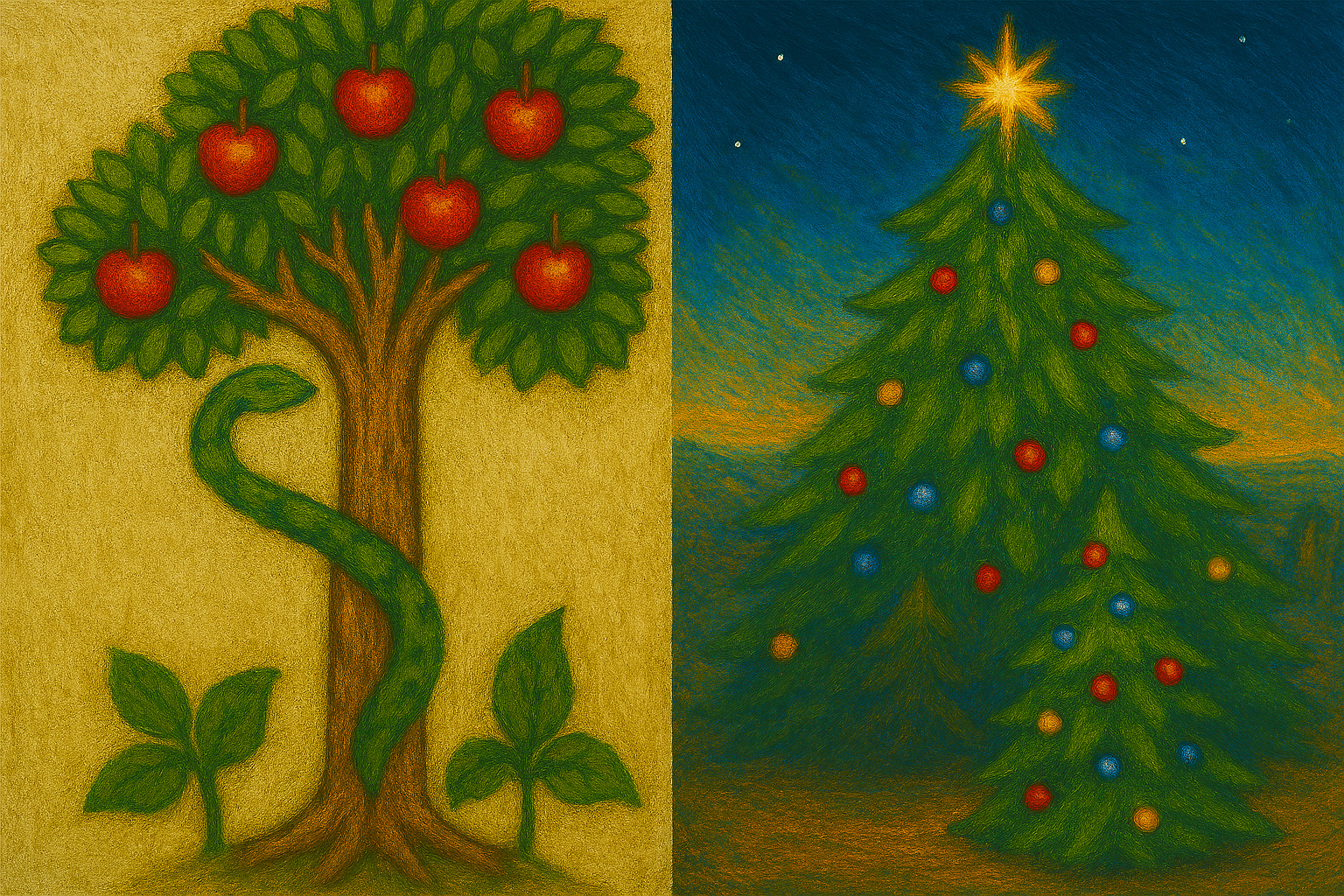
This remembrance often took visible, embodied form. In medieval “Paradise Plays,” performed on December 24, Christians dramatized the story of Genesis. A tree, representing the Garden of Eden, stood at the center. It was adorned with fruit, often apples, symbolizing both the beauty of creation and the tragedy of sin.
This was not pagan worship. It was biblical storytelling.
The evergreen tree, in particular, served as a powerful image. It represented life enduring through winter, hope standing firm in barrenness, and creation awaiting restoration. The symbolism was not borrowed from paganism; it was drawn directly from Christian theology and Scripture.
ATTENTION! I want to alert you to my Free booklet of 15+ Christmas myths! Check it out and tell me what you think. Grab yours by clicking the below link and I’ll also send you the latest iApologia updates!
15+ Myths of Christmas the Bible Doesn’t Teach
December 25: Not Pagan, but Theological
The following day, December 25, celebrated the birth of Christ.
Contrary to popular claims, this date was not selected because of pagan festivals. Long before the Roman emperor Aurelian established the festival of Sol Invictus in AD 274, Christians were already reflecting on the timing of Christ’s life using theological reasoning.
Early Christians believed that great redemptive acts occurred in perfect harmony. A widespread tradition held that Jesus was conceived on the same date He would later die, March 25. Count forward nine months, and you arrive at December 25.
This approach, sometimes called the integral age hypothesis, appears in early Christian writings and reflects a worldview where history is not random, but providentially ordered.
In other words, Christmas did not arise from cultural convenience, but from doctrinal conviction.
From First Adam to Second Adam: A Deliberate Sequence
Once December 25 was recognized as the celebration of Christ’s birth, December 24 naturally took on deeper meaning.
The sequence was unmistakable:
- December 24, Adam and Eve, the Fall, and exile from Eden
- December 25, Christ, the Incarnation, and the beginning of redemption
This was not accidental. It was theological storytelling embedded in time.
Scripture itself frames Christ this way. The Apostle Paul explicitly calls Jesus the Second Adam, the one who restores what the first Adam lost (Romans 5; 1 Corinthians 15). Where Adam disobeyed, Christ obeyed. Where Adam brought death, Christ brought life.
By placing these commemorations back-to-back, the Church taught the gospel not only through preaching, but through calendar, ritual, and culture.
Fall to redemption. Eden to Bethlehem. The tree of death to the tree of life.
This is not syncretism. It is Christian meaning imposed on the world, exactly as Christians have always done.
The Tree Reconsidered
Much ink has been spilled condemning the Christmas tree as pagan. But historically, the tree that stood in Christian homes and churches during Advent did not point to Norse gods or Roman rites. It pointed backward to Eden and forward to Christ.
The “Paradise Tree” of December 24 eventually moved into the home. Apples gave way to ornaments. Communion wafers gave way to lights. But the meaning endured: life, hope, and restoration through Christ.
Cultures change. Symbols develop. Transformation is not corruption.
Christians did not passively absorb culture. They redeemed it.
ATTENTION! I want to alert you to my Free booklet of 15+ Christmas myths! Check it out and tell me what you think. Grab yours by clicking the below link and I’ll also send you the latest iApologia updates!
15+ Myths of Christmas the Bible Doesn’t Teach
Redeeming Time, Not Abandoning It
Modern skepticism toward Christmas often stems from a fear of impurity, an assumption that if something once overlapped culturally, it must now be rejected spiritually. But Scripture does not teach Christians to abandon the world. It teaches us to disciple it.
Paul warned against judging fellow believers over days and practices (Romans 14). He reminded the Church that idols are nothing and that meaning is determined by truth, not origin (1 Corinthians 8).
The early Church understood this well. Rather than retreating from the calendar, they claimed it. Rather than erasing memory, they reframed it. Rather than abandoning symbols, they filled them with Christ.
Conclusion: From Fall to Fulfillment
December 24 and 25 are not competing holidays. They are a single story told across two days.
On one day, we remember what was lost. On the next, we celebrate what was given.
Adam fell. Christ came.
The tree bore death; the cross bore life.
Winter held the world. Light entered the darkness.
This is not paganism baptized. It is Christianity embodied, faith expressed through time, memory, and culture.
Far from being something Christians should apologize for, it is something we should understand, defend, and pass on.
I would love for you to come along with me and not miss a post! In the future, I plan on giving more resources and answers. Plus, I want to send you a Free Quick Guide why I think science points to God. I would love for you to have this Free Quick Guide and the latest posts straight to your inbox. Please grab your Free Quick Guide why I think science points to God here.
So, what did you think? Feel free to share your thoughts below!
