
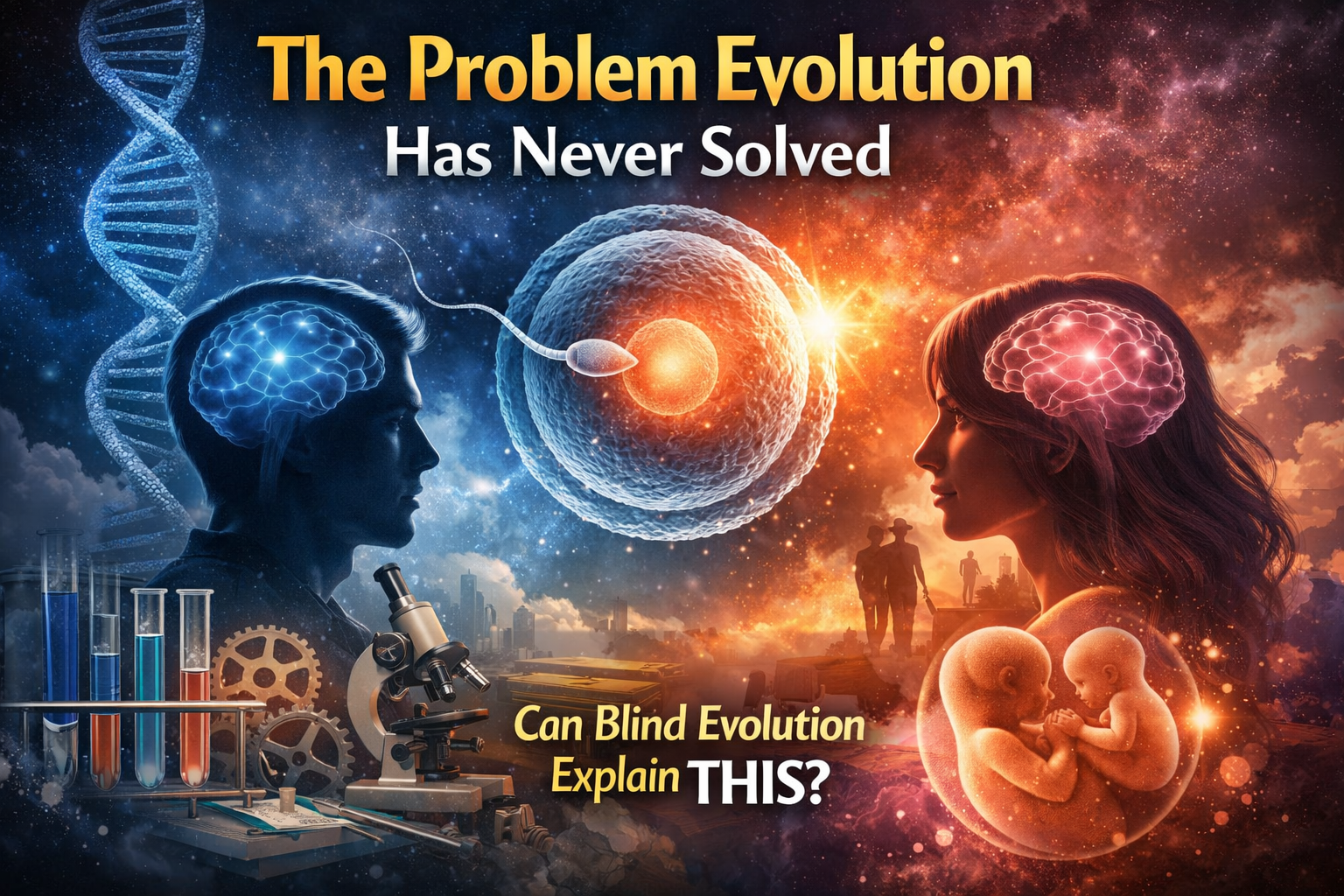
The Problem Evolution Has Never Solved
Materialistic evolutionists often make a bold claim: evolution works because of reproduction. “Look,” they say, “life keeps reproducing, and that’s why anything is possible. Biology can do what our technology cannot, even though our machines, computers, and devices are designed by highly intelligent humans.”

They point to the amazing designs in biology, the heart, the eye, the wings, and say, “See? Nature can do better than what humans can do, but we don’t need a designer here. These things evolved naturally.” It is true that reproduction is one of the things that makes biology different from human technology. Without it, life wouldn’t continue, nor would the designs continue.
But here is the problem: they assume reproduction for their argument. They take it for granted. You see, sexual reproduction is far more complex than anything human engineers have ever built. Every step, every system, every cell in male and female reproduction must work together perfectly. It is not something that could just appear gradually without intelligent design.
So while evolutionists point to the designs in biology as if they somehow prove “no designer needed,” they ignore the one system that makes the assumption of evolutionary processes even possible. And that system, reproduction, is itself so intricate and coordinated that mutation and selection alone cannot explain it.
In other words, if reproduction itself requires design, the whole story changes. That is exactly where evolutionary explanations fall short.
One of Evolution’s Biggest Challenges
There are two prongs to this issue: first, keeping reproduction going; second, how did it start in the first place. Both are big, and neither are fringe issues. Evolutionary biologists themselves admit it is a puzzle. Sex is costly, tricky, and seems inefficient. Scientists even call it the “paradox of sex,” and some say it is the queen of problems for evolution.
The problem is not that we lack understanding. Modern biology has given us amazing detail about how sex works. The problem is that these details show just how precise and coordinated the process is, something very hard to explain if we grant that evolution happens in small and random steps.
Why Sex Is the Real Challenge
Sexual reproduction is not just about one cell meeting another. Rather, it is incredibly complex. Every part of the male and female reproductive systems has to work together perfectly. The sperm has to be built right, able to move and survive. The egg has to be ready at exactly the right time. Hormones, muscles, fluids, and even tiny cellular signals all need to line up in perfect coordination. None of this works if only part of the system exists. Male systems alone? Useless. Female systems alone? Useless. They only function together.
This is what biologists call a coordinated, interdependent system. Evolution cannot “plan ahead.” Natural selection cannot favor traits that reduce reproduction in the short term, even if they might help a population later. But sexual reproduction requires every part to function from the start, or nothing works.
So the very thing evolutionists rely on is itself something that cannot be explained by evolution. It is not a small step. It is a huge leap of coordination, timing, and precision, so intricate that it looks and behaves like design.
 The Two Big Costs of Sex
At the population level, sex seems like a losing strategy. Half of the offspring in sexual reproduction are male, and males cannot directly produce babies. In asexual populations, every individual can reproduce, so asexual lineages can grow roughly twice as fast. This is called the two-fold cost of sex.
There is another cost: genetic dilution. Many evolutionists say that the biological purpose of life is just to pass on genes to the next generation. Sexual organisms pass on only half their genes to each offspring, while asexual organisms pass on all of them. From the standpoint of preserving successful genes, sex looks inefficient.
Yet sexual reproduction dominates among complex life. Asexual reproduction mostly shows up in simple organisms. This mismatch, sex being costly but widespread, is exactly what makes this a big problem.
Maintenance vs Origin
Some explanations talk about why sex continues once it exists. The Red Queen Hypothesis, for example, suggests sex mixes up genes so populations can stay ahead of parasites. Other ideas say sex helps get rid of harmful mutations or stabilizes a species’ genetic identity.
These explanations might partially explain why sex persists, but they do not explain how it started. Evolution cannot plan for the future. Traits that reduce reproduction in the short term will not survive just because they might help the population later.
Meiosis: A Huge Barrier
If you take a basic biology class, you learn about cell division called mitosis. This is how your cells divide so you can grow and heal. Sex requires something else too: meiosis, a special type of cell division. Meiosis is very different from regular cell division. It halves chromosomes, pairs them carefully, allows recombination, and performs two precise divisions.
Mistakes in meiosis often cause infertility or miscarriage. Meiosis only happens in germ cells, eggs and sperm, and must be separate from normal cell division.
No step-by-step evolutionary path shows how meiosis could appear gradually without making reproduction impossible at every stage.
Male and Female Systems Must Work Together
Sex does not just involve cells; it involves entire biological systems. Male and female reproductive systems only function together. One half alone is useless. Explaining their origin means explaining multiple interdependent systems appearing at the same time.
Male systems include:
-
Brain signals for arousal
-
Blood flow and erection control
-
Ejaculation timing and chemistry
-
Sperm energy, movement, and navigation
Female systems include:
-
Brain and hormonal signaling (estrogen, progesterone, oxytocin)
-
Vaginal lubrication and tissue protection
-
Cervical mucus to filter and guide sperm
-
Ovulation timing
-
Egg surface receptors and blocks to multiple fertilizations
-
Initiation of embryo development
None of these systems work alone. They must all be present, synchronized, and compatible.
 Emotion, Desire, and Attraction
Sexual reproduction is not only a biological process; it is deeply connected to emotion, desire, and attraction. Humans and many animals are designed to experience desire and emotional connection that drives reproductive behavior. Hormones influence feelings of attraction, bonding, and care, which ensure mating and investment in offspring.
These emotional systems are fully integrated with the physical reproductive systems. Male and female attraction, desire, and bonding mechanisms are just as essential to reproduction as sperm and eggs. Explaining these traits purely by random mutation is even more difficult because they involve complex neurological, hormonal, and social coordination, all aligned to support reproduction and survival of the species.
A Coordination Problem
Sex requires many systems working together across different individuals. Every part must function from the start. Evolutionary scenarios have not explained how all this coordination could happen gradually.
From a scientific perspective, this is called irreducible complexity: sexual reproduction only works when all the parts are already in place.
Why Evolution Still Struggles
Evolutionary biology recognizes this problem. Where is the evidence-based, detailed evolutionary model that shows how these systems could have arisen gradually while keeping reproduction possible? Sure, you can just assume that some sort of naturalistic mechanism in the past created it, but that is just a gap filler, or a “naturalism of the gaps” argument. This is a logical fallacy.
Systems Biology Points to Design
Here is what we know: sexual reproduction requires:
-
Information-rich coordination
-
Complementary male and female systems
-
Multi-system functionality working at the same time
-
Tight regulatory control
In every other field, systems like this, complex, integrated, and coordinated, come from intelligent design, not blind, random processes. This is not a gap-filler argument. This is evidence pointing to an intelligent designer. It makes total sense that life was created already capable of reproduction, rather than pieced together slowly by chance.
I would love for you to come along with me and not miss a post! In the future, I plan on giving more resources and answers. Plus, I want to send you a Free Quick Guide why I think science points to God. I would love for you to have this Free Quick Guide and the latest posts straight to your inbox. Please grab your Free Quick Guide why I think science points to God here.
So, what did you think? Feel free to share your thoughts below!
