
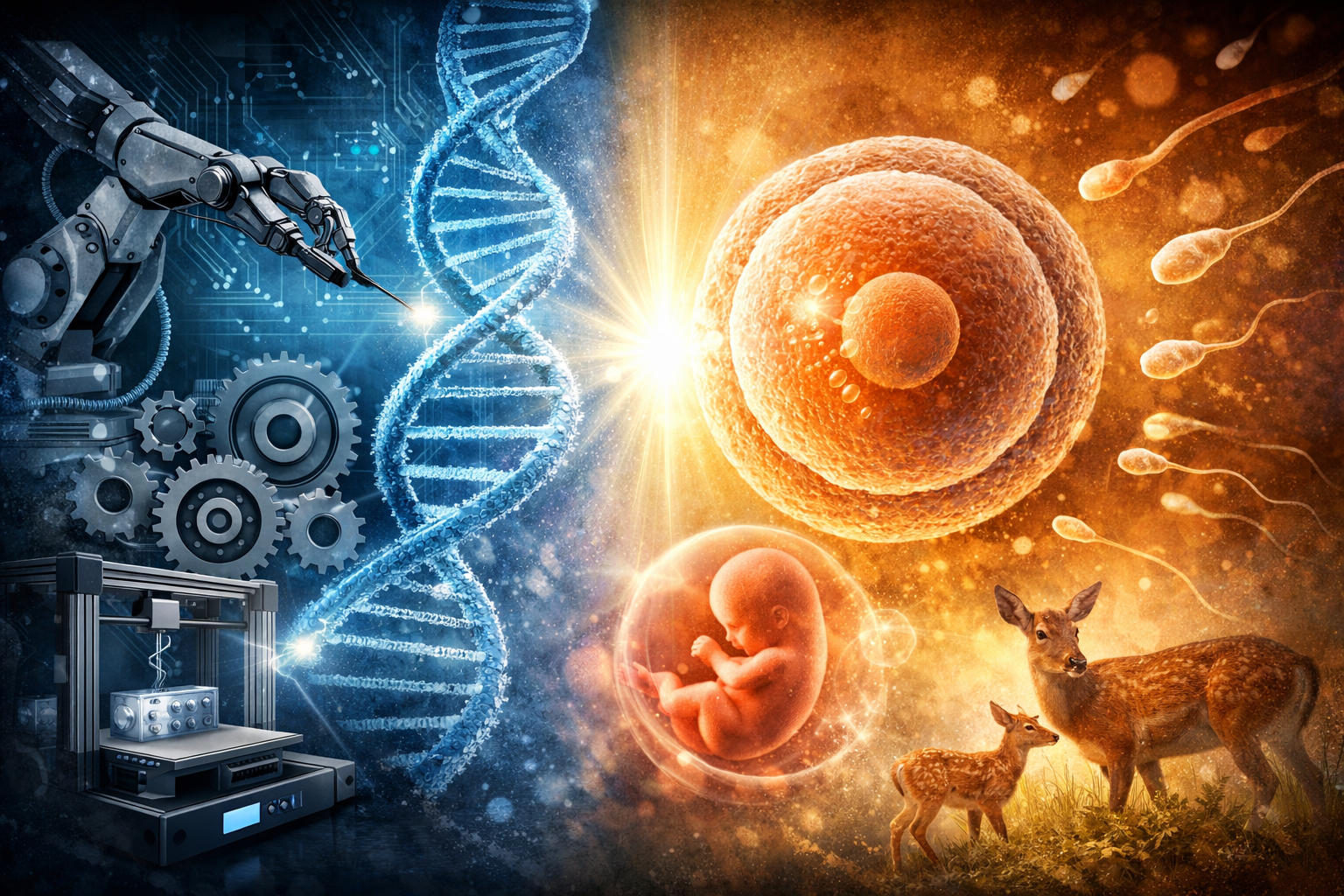
The gulf between human artifacts and biological reproduction is not merely vast; it is orders of magnitude beyond anything our engineering can bridge. Comparing even our most sophisticated human-made replicators such as factories, robots, 3D printers, self-assembling nanomaterials, or AI-driven systems to a living cell is like holding up a crudely carved wooden wheel against a modern electric motor, or more accurately, against a self-repairing, self-optimizing, energy-harvesting factory that writes its own blueprints and produces identical daughter factories while adapting to unforeseen conditions.
A single bacterial cell, the simplest self-reproducing life form, contains thousands of distinct molecular machines, an information system encoded in DNA with precise regulatory networks, and layers of error detection, repair, and quality control at every level. Ribosomes must assemble correctly, ATP synthase rotors spin at thousands of revolutions per minute, and signaling cascades fire in exact sequences during division. These components do not merely coexist; they interlock with exquisite specificity. A single misplaced atom or mistimed gene expression can doom the entire system, yet cells achieve astonishing fidelity across billions of divisions.
 Human artifacts fail dramatically at this point. We can assemble cars or computers in factories, but those factories do not self-replicate. The machines inside do not manufacture themselves from raw environmental materials while maintaining homeostasis. Even our best attempts at synthetic self-replication still rely entirely on pre-existing biological machinery, highly controlled laboratory conditions, and massive external energy and information inputs. Synthetic biology has produced minimal cells, but they are stripped-down parasites on existing life systems, not true de novo self-replicators.
Life approaches a near-perpetual cycle. An organism grows, reproduces, ages, and dies, yet the lineage persists. Energy flows through the system, but the informational and organizational continuity recycles and propagates with remarkable efficiency. Waste from one organism becomes feedstock for another. Mutations combined with selection do not adequately explain this level of integrated, self-sustaining complexity.
Humanity must approach the engineering of life with humility. Biological life continues in noisy, fluctuating environments with built-in robustness that our rigid engineering rarely matches. Life does not merely reproduce; it anticipates needs through regulatory foresight encoded in genomes shaped by superior design.
The Precision and Purpose of Mammalian Reproduction
Human and mammalian reproduction is one of the most intricate and awe-inspiring biological processes. From the moment of conception to the birth of a fully formed mammal, countless processes occur with extraordinary precision. Reproduction reveals not only remarkable science but also profound evidence of design, purpose, and divine wisdom.
The Precision of Gametes
Reproduction begins with gametes, the sperm and egg. Each is a marvel of biological engineering. Sperm cells are highly specialized, streamlined for mobility, and equipped with enzymes that allow them to penetrate the egg’s protective layers. Eggs are large, nutrient-rich, and carefully orchestrated to support the earliest stages of embryonic development.
From a scientific standpoint, this demonstrates extraordinary specialization and reflects intentional intelligent design. Each cell is encoded with precise genetic information that guides development, showing foresight and purpose in creation.
Fertilization: A Remarkable Encounter
The moment when sperm meets egg is not just a chemical interaction; it is a highly regulated process involving molecular recognition, signaling, and timing. Only one sperm typically succeeds, triggering the egg to complete meiosis and initiate a cascade of developmental steps.
This lock-and-key mechanism reflects a sophisticated design. Every molecular interaction must occur in the right sequence, or development fails. The probability of this occurring purely by accident is extraordinarily low.
Embryonic Development: Complexity in Action
Once fertilization occurs, the zygote begins an intricate journey of cell division, differentiation, and morphogenesis. Stem cells specialize into tissues, organs, and systems. Signaling pathways, transcription factors, and epigenetic mechanisms guide development with extraordinary accuracy.
 Consider the human brain, one of the most complex structures known. Its development depends on precise timing and coordination at cellular and molecular levels. Any deviation can result in failure or serious defects. The complexity and interdependence observed in embryonic development strongly suggest intentional design rather than blind chance.
Mammalian Reproduction Beyond Humans
Mammalian reproduction offers overwhelming evidence of design. Gestation periods, maternal-fetal nutrient transfer, hormonal regulation, and birth are finely tuned. The placenta supplies nutrients and oxygen, provides immune protection, and removes waste—an organ far more sophisticated than any human-engineered counterpart.
Different mammals have reproductive strategies suited to their environments, from the short gestation of mice to the long gestation of elephants. These strategies reflect both functional adaptation and underlying intentionality in the design of life.
Reproduction also underscores the sanctity of life. Every life begins with a carefully designed sequence, reflecting purpose and intrinsic value.
The Unified Case for Intelligent Design
When the staggering complexity of cellular reproduction is combined with the precision of mammalian reproduction, a single conclusion emerges with clarity. The cumulative weight of information density, interdependence, regulatory foresight, and functional coherence points far beyond accidental processes. Life bears the unmistakable marks of intentional, purposeful design.
Its integrated systems, encoded instructions, and self-replicating machinery reflect the work of a Creator whose intelligence surpasses anything human engineering has ever approached. Biological life is not an accident of chemistry; it is the handiwork of God, the only mind capable of producing such depth, order, and brilliance.
I would love for you to come along with me and not miss a post! In the future, I plan on giving more resources and answers. Plus, I want to send you a Free Quick Guide why I think science points to God. I would love for you to have this Free Quick Guide and the latest posts straight to your inbox. Please grab your Free Quick Guide why I think science points to God here.
So, what did you think? Feel free to share your thoughts below!
